
Last reviewed
Background
A northern Guangxi landscape where limestone towers, rivers and historic transport routes meet a lived-in regional city.
Guilin's limestone towers, caves and river corridors belong to one of southern China's most distinctive karst regions. The Li River runs from the urban area toward Yangshuo through scenery long represented in painting, poetry and travel culture, but the Destination is broader than a single cruise: city hills, farming valleys, ancient settlements and terraced mountain slopes all reveal different relationships between people and the terrain.
The prefecture-level Destination includes Guilin city, Yangshuo, Longsheng and Xing'an, so travel times matter. Guilin provides museums, historic water systems and an arrival base; Yangshuo opens the Li and Yulong river landscapes; Longji's terraces record generations of mountain agriculture; and Lingqu Canal connects the region to an early imperial transport project. Treat communities as contemporary places, not scenery staged for visitors.
Recommended itineraries
Recommended itineraries
Build the trip around one river journey and one landscape per day. Old transport, ticket and rafting details from the source have been omitted; confirm current licensed services and weather before departure.
Guilin, the Li River and Yangshuo
A first visit combining the historic city, a managed river journey and Yangshuo's quieter countryside.
- Day 1 · Walk the Rong and Shan lake area, visit Jingjiang Princes City and Duxiu Peak, then choose Elephant Trunk Hill or Reed Flute Cave rather than rushing through both.
- Day 2 · Travel through the Li River landscape on a currently authorized cruise or other regulated route, continue to Xingping for riverside views and finish in Yangshuo.
- Day 3 · Explore the Yulong River valley by a licensed activity or a village-and-field walk, then return through Yangshuo without treating West Street as the whole town.
Karst, terraces and Lingqu Canal
A slower regional route that gives Guilin's outlying cultural landscapes their own days.
- Day 1 · Guilin's lakes, Jingjiang Princes City, Duxiu Peak and one central hill or museum.
- Day 2 · Follow the Li River corridor to Xingping and Yangshuo using a current authorized service.
- Day 3 · Walk or cycle a suitable public route in the Yulong River valley and allow time for village life and weather changes.
- Day 4 · Make Longji Rice Terraces the day's only major excursion, selecting one managed village area and confirming road and trail conditions.
- Day 5 · Visit Lingqu Canal in Xing'an for engineering and historical context, or substitute Daxu Ancient Town if current access and onward transport make it a better fit.
Attractions & practical tips
What to see—and how to approach it.
Li River karst corridor
漓江
Between Guilin and Yangshuo, the Li River threads past densely grouped limestone towers, farming settlements and tributary valleys within the wider South China Karst landscape.
Practical tips
- Choose a currently authorized cruise or transfer and confirm the exact pier, route and identity-document requirements before departure.
- River levels, fog, storms and conservation controls can alter routes; leave margin and avoid unregulated craft.
Two Rivers and Four Lakes
两江四湖
A linked urban water system joins the Li and Taohua rivers with Rong, Shan, Gui and Mulong lakes, framing bridges, trees, historic remains and contemporary night lighting.
Practical tips
- A walk around Rong and Shan lakes gives a flexible, ticket-free introduction without committing to a full boat circuit.
- Use lit public paths after dark, protect against mosquitoes and do not rely on the source's old cruise details.
Elephant Trunk Hill
象鼻山
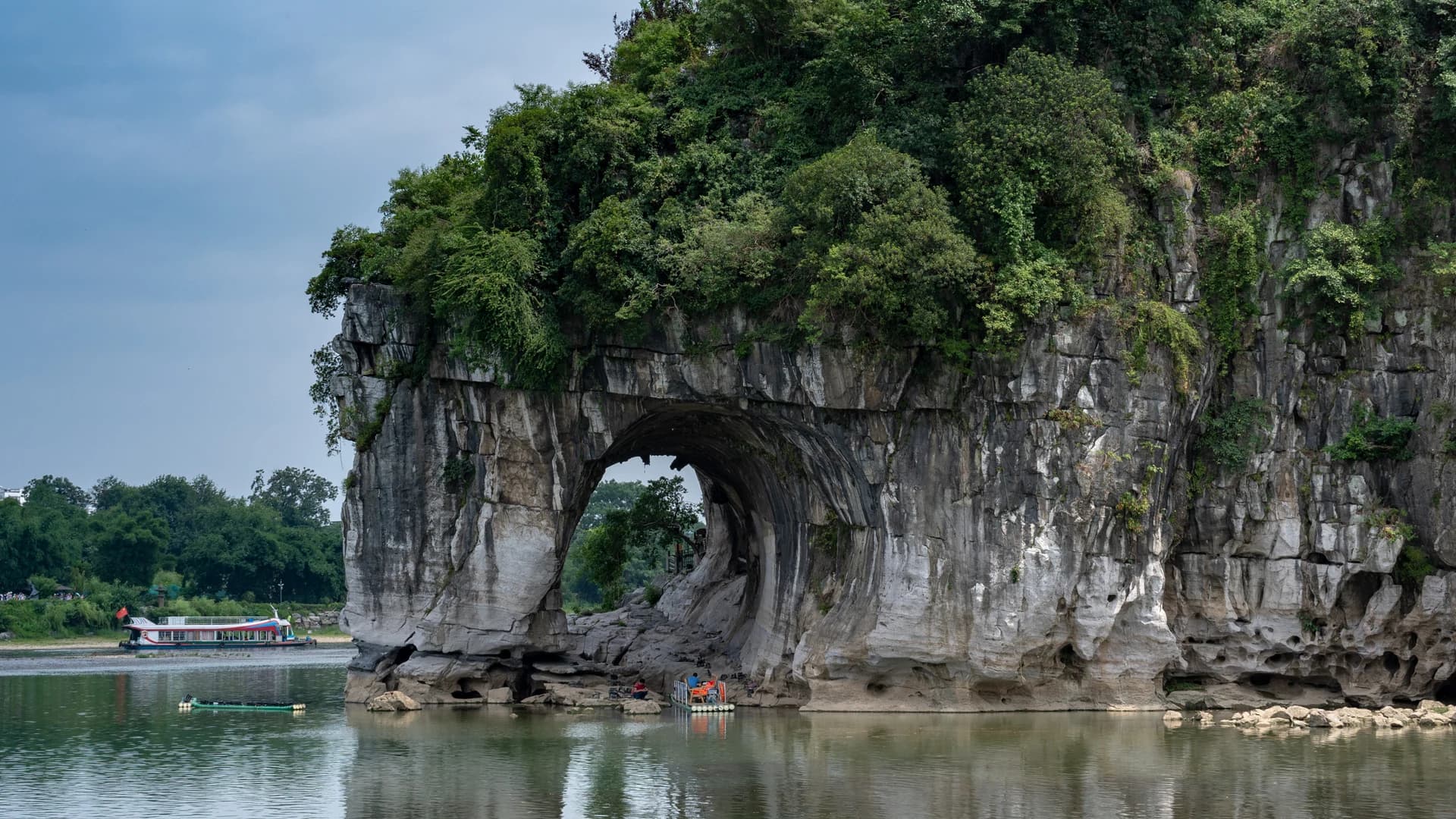
A riverside limestone arch creates the elephant-like profile that has become Guilin's best-known civic symbol.
Practical tips
- Treat the shape and its legends as an introduction to Guilin's visual culture rather than the Destination's only essential landscape.
- Confirm current entrances and viewpoints, and avoid climbing closed or wet rock.
Jingjiang Princes City and Duxiu Peak
靖江王城与独秀峰
The former Ming princely compound and its surviving walls surround Duxiu Peak in central Guilin, linking the city's political history, education and long literary association with its landscape.
Practical tips
- Separate the public streets and outer walls from ticketed or university-controlled areas and follow current access signs.
- The peak has steep steps; skip the climb in rain or heat if footing or visibility is poor.
Reed Flute Cave
芦笛岩
A developed limestone cave northwest of central Guilin displays chambers of stalactites, stalagmites and flowstone formed through long-term dissolution and mineral deposition.
Practical tips
- Expect artificial colored lighting and managed walkways rather than an untouched cave environment.
- Wear shoes with grip, follow barriers and bring a light layer for the cooler interior.
Yulong River valley
遇龙河
A tributary valley near Yangshuo combines close karst peaks, fields, villages, old bridges and slower waterways into a more intimate landscape than the main Li River corridor.
Practical tips
- Use only regulated rafting, cycling or walking routes and check weather, water levels, helmets and life jackets before any water activity.
- Keep off crops and private property, slow down through villages and ask before photographing residents.
Xingping and the Li River
兴坪古镇与漓江
Xingping sits at a dramatic bend in the Li River, where old lanes, working riverfront spaces and nearby karst viewpoints make a useful base for understanding the corridor beyond a through-cruise.
Practical tips
- Allow time beyond the busiest photo point and remember that the old town remains a residential and commercial community.
- Do not enter informal riverside paths during flooding, darkness or official closure.
Longji Rice Terraces
龙脊梯田
Mountain slopes in Longsheng have been shaped into layered rice terraces around Zhuang and Yao communities, creating a living agricultural landscape that changes with planting, water, growth and harvest.
Practical tips
- Choose one managed village and trail network rather than trying to cross every terrace area in a day.
- Check rain, landslide, road and trail conditions; stay on paths, respect farm work and never present residents as tourist props.
Lingqu Canal
灵渠
Built in the Qin period at Xing'an, Lingqu connected the Xiang and Li river systems and became a major engineering link between the Yangtze and Pearl River basins.
Practical tips
- Use museum or on-site interpretation to understand the watershed engineering before walking the surviving canal sections.
- This is a separate Xing'an excursion; confirm current transport and protected-area access instead of using the source's old bus details.
Daxu Ancient Town
大圩古镇
An old market settlement on the east bank of the Li River preserves lanes, shop-house forms and traces of the waterborne trade that connected northern Guangxi.
Practical tips
- Expect a lived-in settlement with uneven conservation, not a sealed historical display.
- Walk public lanes only, ask before photographing people or homes and verify transport back to Guilin.
Seven Star Park
七星公园
A large east-bank city park bringing together karst hills, Seven Star Cave, the historic Flower Bridge, stone inscriptions and ordinary public green space.
Practical tips
- Decide whether you want the outdoor park, the separately managed cave or both; the PDF’s old bundled tickets and opening times are not current guidance.
- Stay on marked steps and cave walkways, avoid feeding wildlife and leave extra time if heat or rain makes the limestone paths slippery.
Fubo Hill
伏波山
A compact limestone hill on the Li River, where riverside gardens, Return Pearl Cave, carved images and inscriptions layer Guilin’s landscape with centuries of urban history.
Practical tips
- The climb is short but steep and the cave surfaces can be damp; use handrails and skip narrow or closed sections in poor weather.
- Read legends and historical interpretations separately, and never touch carvings or rock-cut images.
Folded Brocade Hill
叠彩山
A group of central Guilin peaks known for layered rock, the Wind Cave, historic inscriptions and a broad city-and-river view from the upper paths.
Practical tips
- Climb early or late in hot weather, carry water and avoid exposed steps during rain, lightning or poor visibility.
- Combine the hill with the nearby riverfront or Fubo Hill rather than crossing the city for another major excursion.
Silver Cave
银子岩
A developed multi-level karst cave in Lipu, south of Yangshuo, with dense stalactite, stalagmite and flowstone formations presented along a managed visitor route.
Practical tips
- Treat it as a separate Lipu excursion and verify current transport and entry arrangements instead of adding it casually to a packed Yangshuo day.
- Expect colored lighting, crowds, damp steps and a cooler interior; wear shoes with grip and remain behind barriers.
Mao’er Mountain
猫儿山
A high, forested massif in Xing’an County and a remote contrast to Guilin’s river-valley karst, best approached as a dedicated nature excursion rather than a city add-on.
Practical tips
- Use the managed scenic route and current transport, reservation and trail information; the mountain is too far from central Guilin for an improvised half-day.
- Carry layers and rain protection, turn back for storms or poor visibility and do not enter closed forest or summit areas.
Food & dining
Eat with a little local context.
Guilin's food combines rice noodles, sour and chilli flavors, river and field ingredients, and county specialties. Prefer busy kitchens, ask clearly about meat, fish bones, peanuts and cooking alcohol, and treat old medicinal claims as culture rather than health advice.
Guilin rice noodles
桂林米粉
Fresh rice noodles are topped with sliced braised meat and a concentrated savory brine, then customized with pickles, beans, scallions and chilli before broth is added or served separately.
Try it this way: Watch how local diners order, begin with a small bowl and ask about pork, offal, peanuts and chilli.
Yangshuo beer fish
阳朔啤酒鱼
A whole freshwater fish is braised with beer, tomato, chilli and aromatics into a rich shared dish associated with Yangshuo.
Try it this way: Agree on the fish species, weight and price before cooking, expect bones and disclose alcohol or fish allergies.
Lipu taro with pork
荔浦芋扣肉
Slices of dense Lipu taro and pork belly are layered and steamed with a savory fermented-bean sauce for a classic Guangxi banquet dish.
Try it this way: It is rich and usually large enough to share; ask whether fermented tofu, alcohol or other allergens are in the sauce.
Guangxi oil tea
油茶
Tea leaves, ginger and oil are pounded and cooked into a savory, lightly bitter drink served with crisp rice, peanuts and other small accompaniments.
Try it this way: Try a small bowl first and mention peanut, sesame or caffeine sensitivities.
Glutinous-rice ciba
糍粑
Pounded glutinous rice becomes a chewy cake served plain, toasted or filled and coated with sugar, sesame or peanut.
Try it this way: Ask about the coating or filling and take small bites because the texture is very sticky.
Water chestnut cake
马蹄糕
A translucent steamed cake uses water-chestnut starch and chopped water chestnuts for a gently sweet, springy snack.
Try it this way: Choose a freshly made portion from a clean counter and ask about added nuts or coconut if allergies matter.
FAQ
Questions worth answering before you go.
How many days should I spend in Guilin?
Three days cover Guilin city, one Li River journey and a day around Yangshuo. Four or five days allow Longji, Lingqu or a slower countryside day without turning the trip into constant transfers.
Should I stay in Guilin or Yangshuo?
Use Guilin for rail and air connections, city history and northern excursions; use Yangshuo for the Yulong valley and a slower countryside base. Splitting nights is usually better than repeating the transfer, provided your luggage and onward schedule allow it.
How should I choose a Li or Yulong River activity?
Use an authorized operator, confirm the exact route and age or health restrictions, and inspect required safety equipment. Heavy rain, high water, thunderstorms or official controls can suspend activities; never substitute an informal boat or swimming route.
When is the best time to visit?
Spring brings mist and rain, summer brings heat and possible flooding, and autumn often offers easier walking and clearer conditions. Longji looks different during flooded planting, green growth and harvest; use current forecasts and agricultural conditions instead of expecting a fixed postcard view.
How can I visit terrace and village areas respectfully?
Stay on public paths, keep out of crops and private homes, ask before photographing people and pay fairly for local services. Zhuang, Yao and other residents are contemporary communities with varied lives, not costumes or performances automatically available to visitors.